
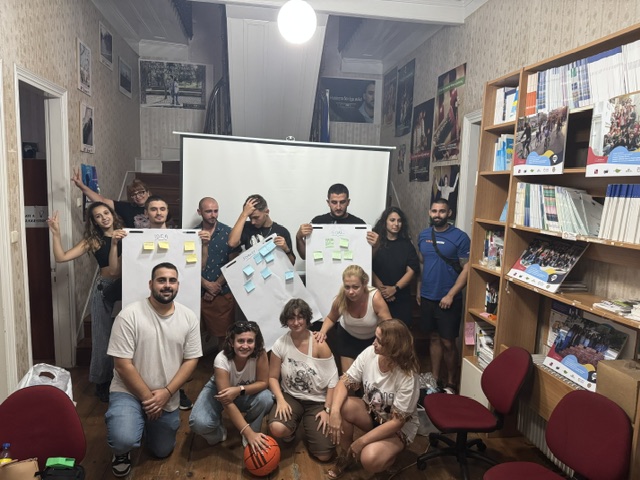
During Days 4 and 5 of the Building Bridges: Strengthening International Capacity, Developing Key Competences, and Promoting Inclusion Through Erasmus+ mobility in Komotini, participants moved from discussing social challenges to developing structured project ideas and using digital tools for teamwork.
Day 4: From Challenges to Project Ideas
The fourth day focused on identifying concrete needs within local communities and exploring how these needs could be transformed into future project concepts.
Working individually and in groups, participants discussed a range of social, educational and environmental challenges, including:
- limited civic education among young people;
- barriers faced by wheelchair users;
- the large number of stray animals in Bulgaria;
- unhealthy lifestyles and low participation in amateur sport;
- car-dependent urban environments;
- limited awareness of European values among people outside the European Union.
Each group selected a challenge and began developing a structured response by defining the problem, the target group, the main objective and the type of activities that could be implemented.
The session encouraged participants to move beyond general concerns and think in practical terms about how an initiative could create measurable value for a community. Peer discussion and feedback helped the groups refine their ideas and identify areas requiring further development.
Day 5: Digital Collaboration and Teamwork
The fifth day introduced participants to digital project-management and collaboration tools that can support teamwork, communication and the organisation of tasks.
Through practical exercises, participants explored platforms including Trello, Asana and Monday.com. They learned how to:
- create and organise tasks;
- assign responsibilities;
- establish deadlines and timelines;
- monitor progress;
- share information within a team;
- improve transparency and accountability.
Rather than only observing demonstrations, participants applied the tools to their own developing project ideas. This allowed them to see how digital platforms can support the planning and coordination of educational, community and international projects.
The day also included team-building and reflection activities focused on effective communication, division of responsibilities and cooperation within a project team.
By the end of Day 5, participants had both an initial project concept and a clearer understanding of how digital tools can help turn ideas into organised action.
The mobility is implemented under project 2025-1-BG01-KA122-ADU-000323675 and is funded by the European Union.
Funded by the European Union. Views and opinions expressed are, however, those of the author(s) only and do not necessarily reflect those of the European Union or the granting authority. Neither the European Union nor the granting authority can be held responsible for them.
Leave a Reply