
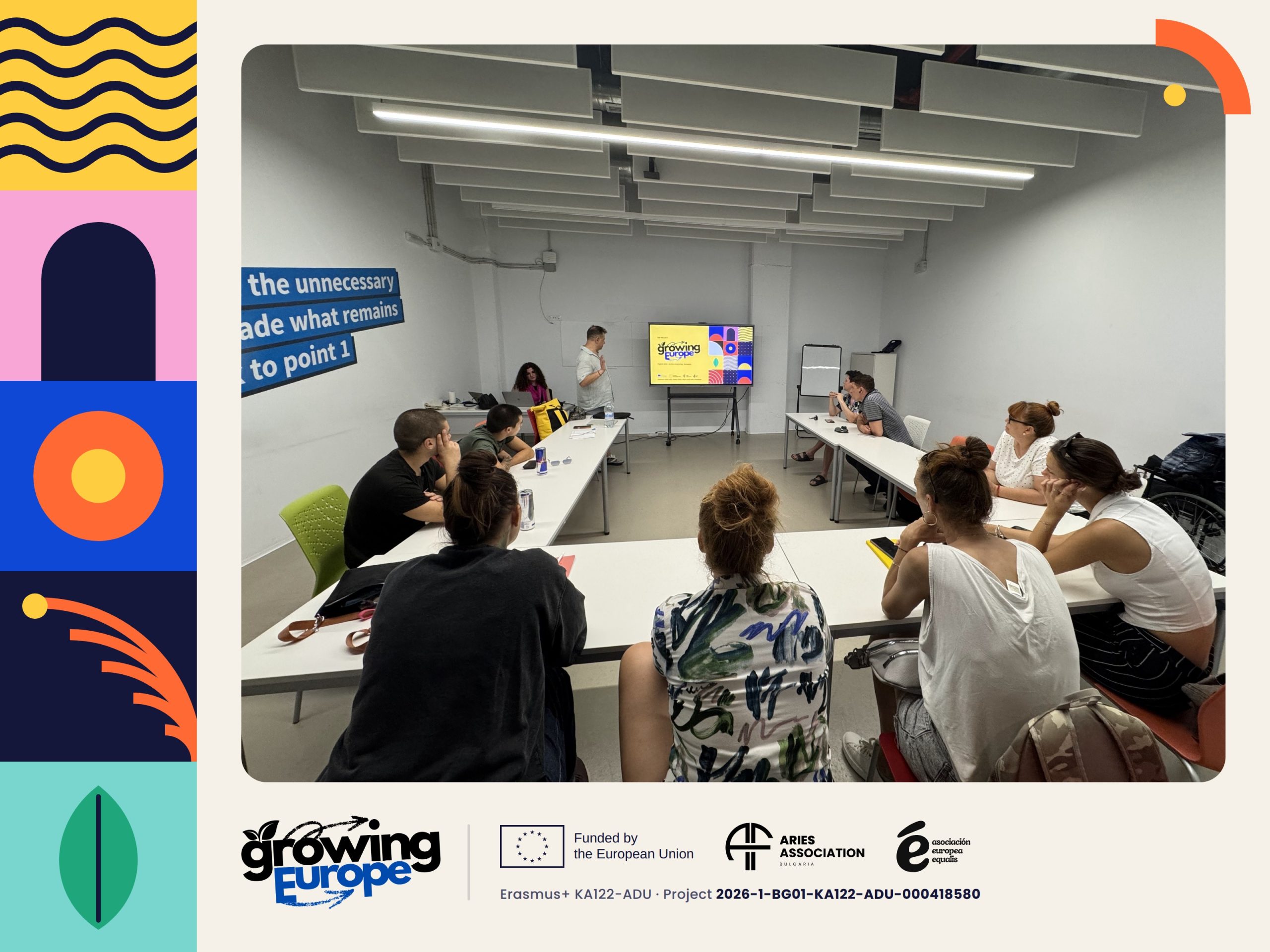
Association Aries is on its second Erasmus+ mobility, and our first time in Alicante. It has been worth every minute from the very first day. A group from Plovdiv and Varna is here for the Growing Europe project (2026-1-BG01-KA122-ADU-000418580), hosted by Asociación Europea Equalis.
A partnership that works
The team of Asociación Europea Equalis welcomed us, put together the programme and connected us with the city in a way only locals can. Thank you to Violeta Paskaleva and the whole Asociación Europea Equalis team. Working with you is a real pleasure!
In love with Alicante
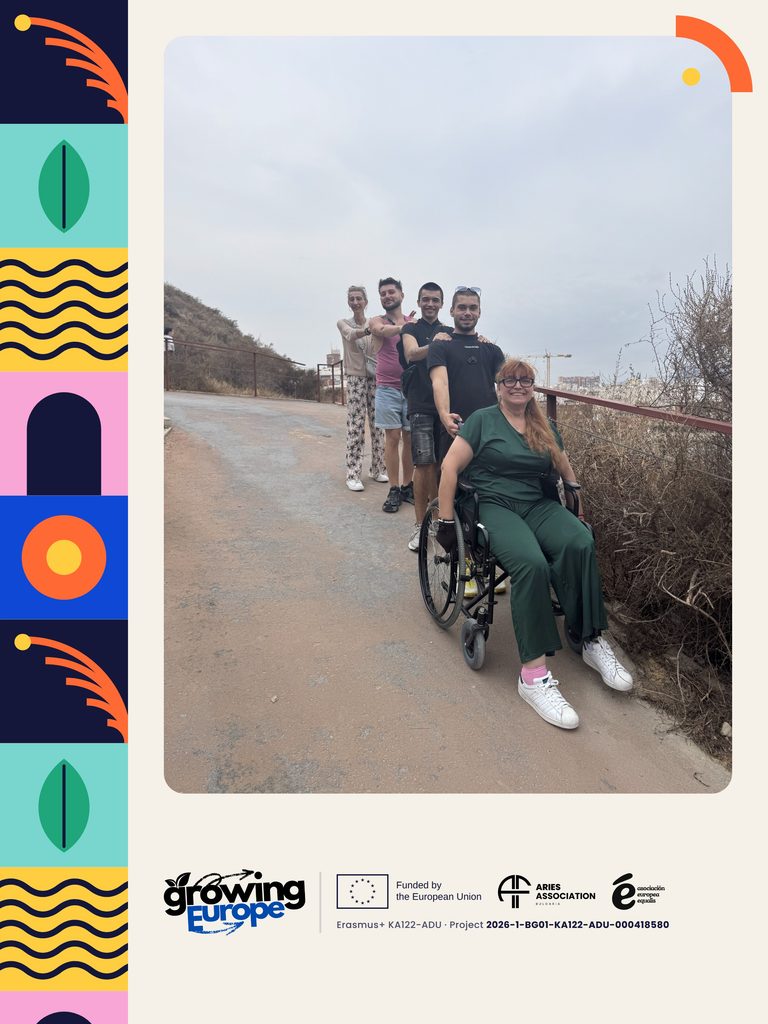
The sea, the light, the streets of the old town, the squares where people spend their evenings together: our participants have truly fallen in love with Alicante. But we are not looking at the city only as tourists. We watch how it cares for its shared spaces and how people meet outdoors, and we ask what we could bring back home.
What we have learned so far
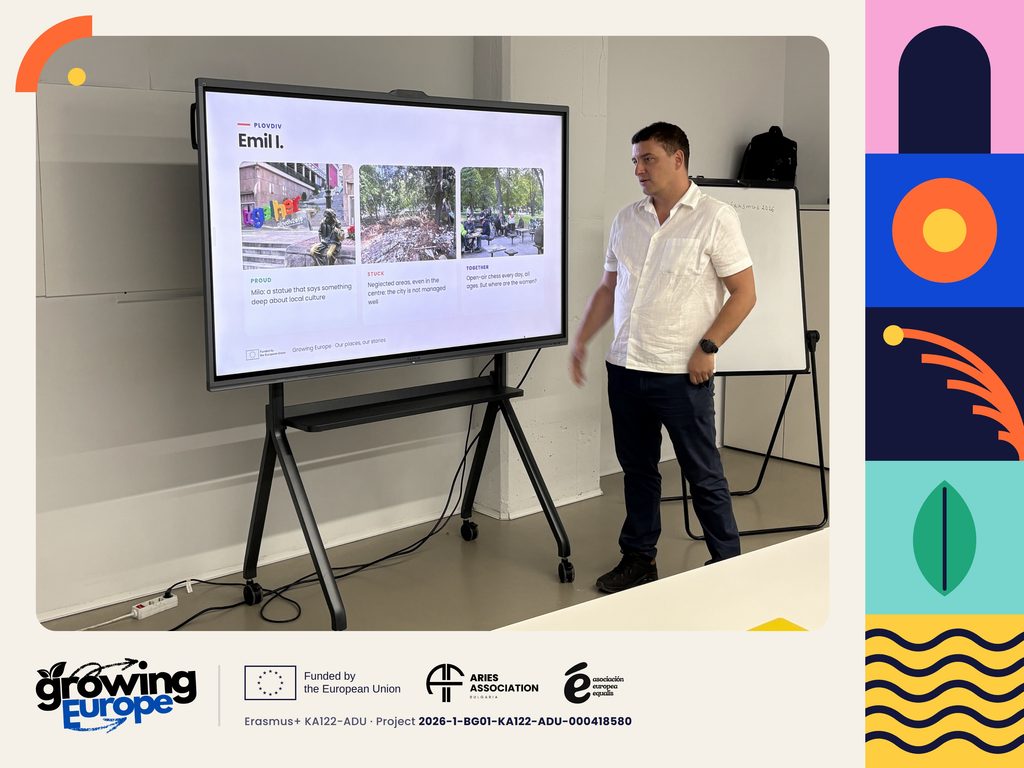
Our towns have more in common than we think. Before the trip, each participant photographed three things in their town: something they are proud of, something that is “stuck” and needs to change, and a place where people come together. When we put the photos side by side, the picture was clear. Four of the six “stuck” photos showed rubbish and neglect. Every “together” photo was a square, a park or a street. And our pride comes mostly from history and culture: the Ancient Theatre, Roman Philippopolis, the Milo statue.
Not everyone is in our shared spaces. Emil’s photo of the chess players in the park made us stop and think. People of all ages are there every day, but almost no women. Who is missing from the places where we meet, and why? This is equality, one of the EU’s values, in an everyday setting.
Knowing who to turn to is half the solution. We looked at five levels: district, municipality, region, national government and the European Union. The rule is to start with the level closest to the problem. Most of what we photographed belongs to the district and the municipality. We learned how to submit a written report and why we should always ask for a registration number. We also learned when to turn to a local public mediator or to the national Ombudsman, which is free and has an office in Plovdiv. And we saw what rights we have as EU citizens: a petition to the European Parliament, a complaint to the European Commission, and the European Citizens’ Initiative, where one million signatures from at least seven countries can ask for a new law.
Democracy is not only voting. It is speaking up about what is wrong, uniting with your neighbours around one problem and acting together. One voice is a complaint; fifty voices are a community.
From words to action
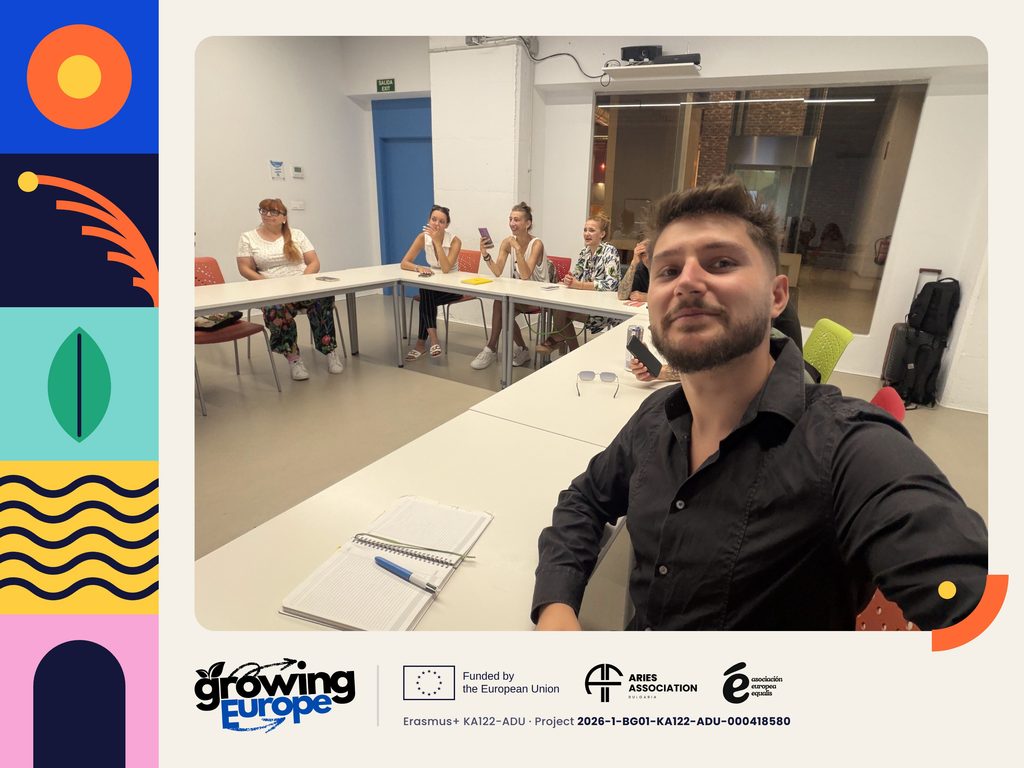
Each participant made a personal pledge: what they want to change at home, what they will do, who they will invite to join, and by when. In small groups we started shaping ideas for community initiatives, and we will come back to them at our online meeting in December.
Half the week is behind us, but the best is still to come. Stay tuned!
Funded by the European Union. Views and opinions expressed are however those of the author(s) only and do not necessarily reflect those of the European Union or the European Education and Culture Executive Agency (EACEA). Neither the European Union nor EACEA can be held responsible for them.
Leave a Reply